Understanding Compressor Filters and Oil Changes
What each filter does, why compressor oil is not interchangeable, and how to read the signs that service is due.
Published by Mechanical Air Services LLC · Written from field experience; not professional engineering advice.
Filters and oil are the consumables that protect everything expensive inside a compressor. Understanding what each one does makes it easier to see why intervals matter.
The filters
Intake (air) filter. Stops dust and debris before it enters the compression chamber. In dusty environments such as woodworking, construction and agriculture, intake filters load quickly. A restricted intake filter reduces output and, on a rotary screw unit, can pull a vacuum that stresses seals.
Oil filter. Removes wear particles and contaminants from the lubricant before it reaches bearings and the air end. A bypassing oil filter sends dirty oil straight to the most sensitive parts of the machine.
Air/oil separator (rotary screw). After compression, the air and oil mixture passes through the separator element, which removes oil so it can return to the sump. A saturated or failed separator causes oil carry-over into the air system and raises the pressure drop across the element, which costs energy.
Inline filters. Downstream particulate, coalescing and activated-carbon filters clean the air for the application. Their elements have a service life and a pressure drop that rises as they load.
Dryer filters and drains. Pre- and after-filters around a dryer and the condensate drains that remove water all need periodic attention.
Compressor oil
Compressor oil is not engine oil. In a rotary screw unit it seals the rotors, carries away heat and lubricates bearings, often at high temperature for thousands of hours. Manufacturers specify lubricant type (mineral, semi-synthetic, synthetic) and viscosity for a reason, and different lubricant chemistries should not be mixed.
Signs that oil service is due or overdue:
- Hour-meter at or past the interval
- Oil that is dark, smells burnt or has a varnish-like appearance
- Foaming in the sight glass
- Rising operating temperature at the same load
- Oil in the air lines
Oil analysis can extend intervals safely on some equipment by measuring wear metals, oxidation and contamination rather than relying on hours alone.
Intervals
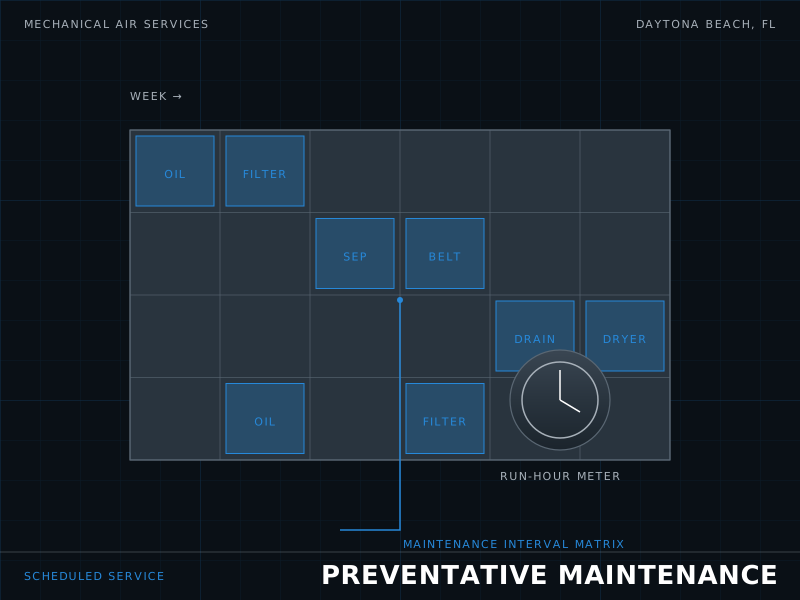
Intervals vary by manufacturer, lubricant type and environment. A unit running in a clean, cool room on synthetic oil can go much longer than the same unit in a hot, dusty shop on mineral oil. Start with the manufacturer’s recommendation, then adjust based on operating conditions and what the oil and filters look like at change-out.
Keeping records
Record the date, hour-meter reading, what was changed and what was observed at each service. Over time these records show whether intervals are right for your conditions and give early warning of developing problems. If you would rather not track it yourself, a maintenance program does this for you.