Mechanical Air Services — home Service · Sales · Rentals

Technical reference

Compressor types
& brands.

Six compressor designs, how they differ, what they need, and the brands we see most. Plain language, no invented specifications.

Types

Select a compressor type.

Reciprocating, rotary screw, centrifugal, scroll, portable and oil-free machines each wear differently and need different care. Select a type to see what we look at.

Compressor types serviced
6 categories
Evaluation per machine

Compressor types

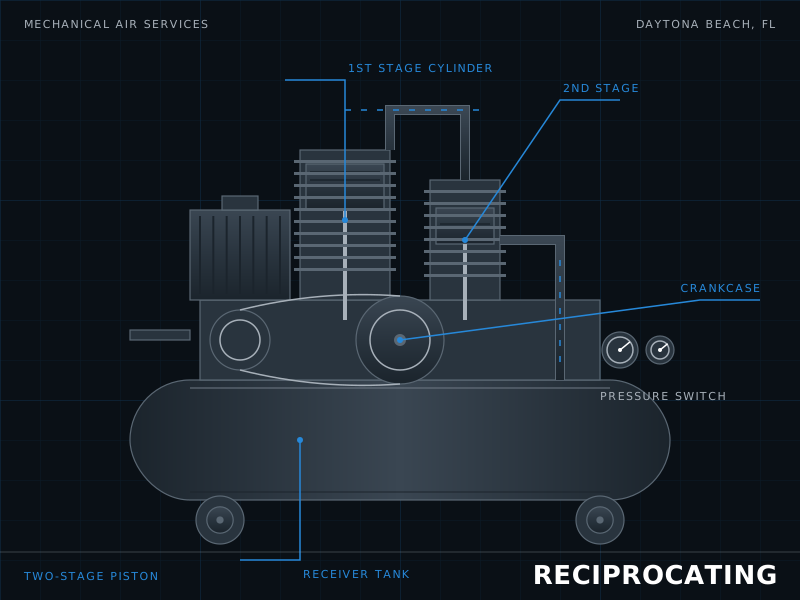
Reciprocating / Piston compressor — technical illustration

Equipment category

Reciprocating / Piston

Reciprocating compressors use one or more pistons driven by a crankshaft to compress air in stages. They are widely used in automotive shops, body shops, woodworking and small manufacturing because they are simple, durable and cost-effective for intermittent duty.

Common maintenance considerations

  • Oil level and change intervals
  • Intake filter condition
  • Valve plate and ring wear
  • Belt tension and alignment
  • Tank drain and moisture

Relevant service options

  • Repair
  • Preventative maintenance
  • Valve and ring rebuilds
  • Installation
  • Parts

Service capability is confirmed per machine after evaluation. Specifications vary by manufacturer and model.

Comparison

Four common designs, side by side.

Generalized
Specifications vary by manufacturer
Attribute Reciprocating Rotary screw Centrifugal Scroll
Design Pistons in cylindersTwo meshing rotorsHigh-speed impellerFixed + orbiting spiral
Duty cycle IntermittentContinuousContinuous (large plants)Continuous (light duty)
Noise / heat HigherLowerVariesVery low
Typical use Shops, garages, light industryManufacturing, body shops, marineLarge steady demandMedical, dental, lab
Key wear items Valves, rings, bearingsAir end bearings, separatorBearings, controlsTip seals, filters

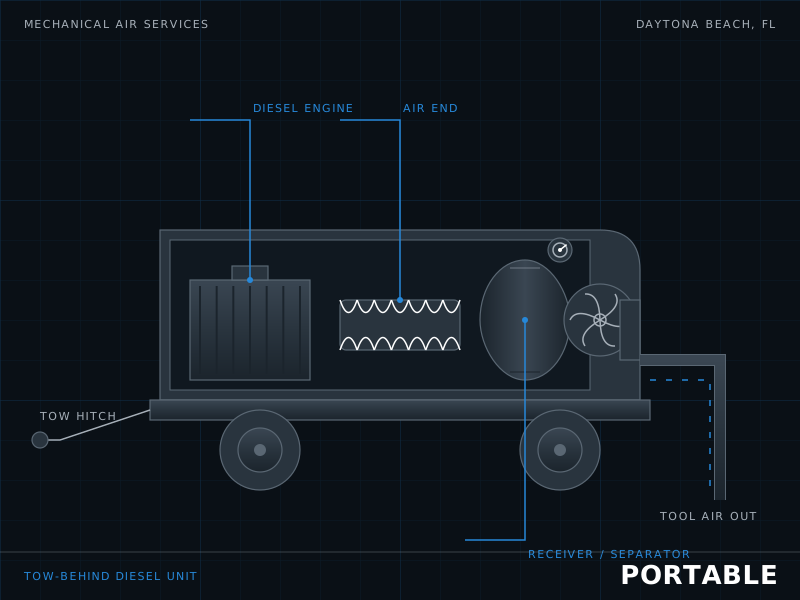
Portable compressors are usually reciprocating or rotary screw elements packaged for transport; oil-free designs exist across several of these categories.

Reference

Type by type.

6 categories

Reciprocating / Piston

Reciprocating compressors use one or more pistons driven by a crankshaft to compress air in stages. They are widely used in automotive shops, body shops, woodworking and small manufacturing because they are simple, durable and cost-effective for intermittent duty.

What we check

  • Oil level and change intervals
  • Intake filter condition
  • Valve plate and ring wear
  • Belt tension and alignment
  • Tank drain and moisture
Request service for this type

Rotary Screw

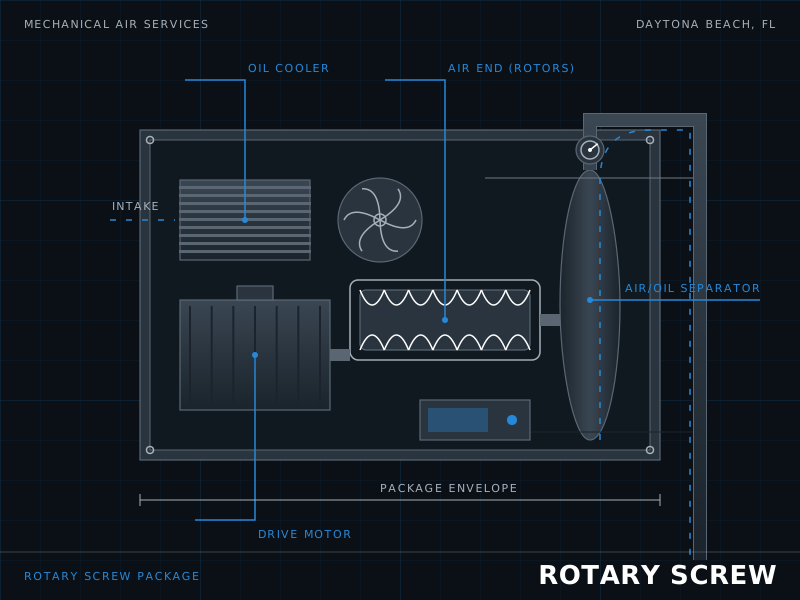
Rotary screw compressors use two intermeshing helical rotors to compress air continuously. They are the workhorse of manufacturing, food & beverage and other continuous-duty applications, and they depend on clean oil, good separation and healthy air-end bearings.

What we check

  • Oil and air/oil separator changes
  • Air end bearing condition
  • Cooler cleanliness and operating temperature
  • Inlet valve and minimum pressure valve
  • Controller settings and fault history
Request service for this type

Centrifugal

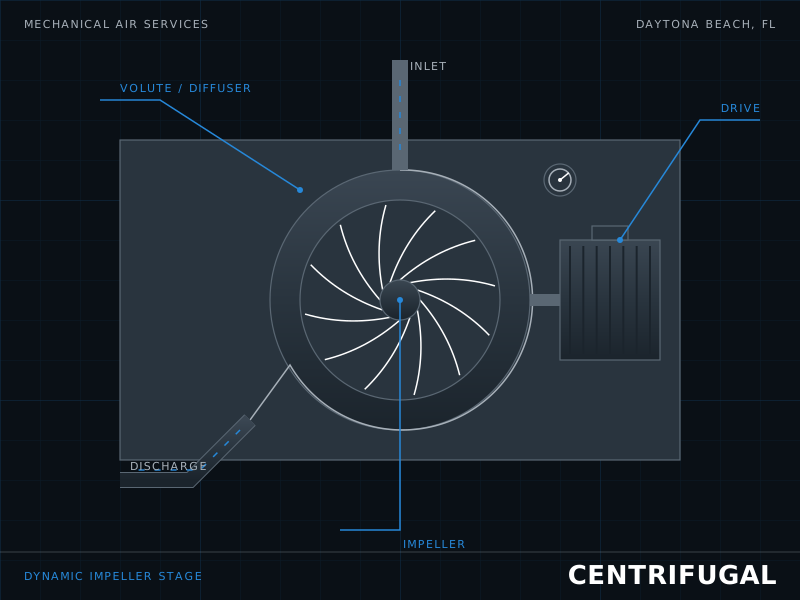
Centrifugal compressors use high-speed impellers to accelerate air and convert velocity into pressure. They serve large plants with steady demand. Service on centrifugal equipment is evaluated case by case based on the specific machine and controls.

What we check

  • Vibration and bearing monitoring
  • Inlet guide vane and control calibration
  • Cooler performance
  • Lubrication system condition
Request service for this type

Scroll

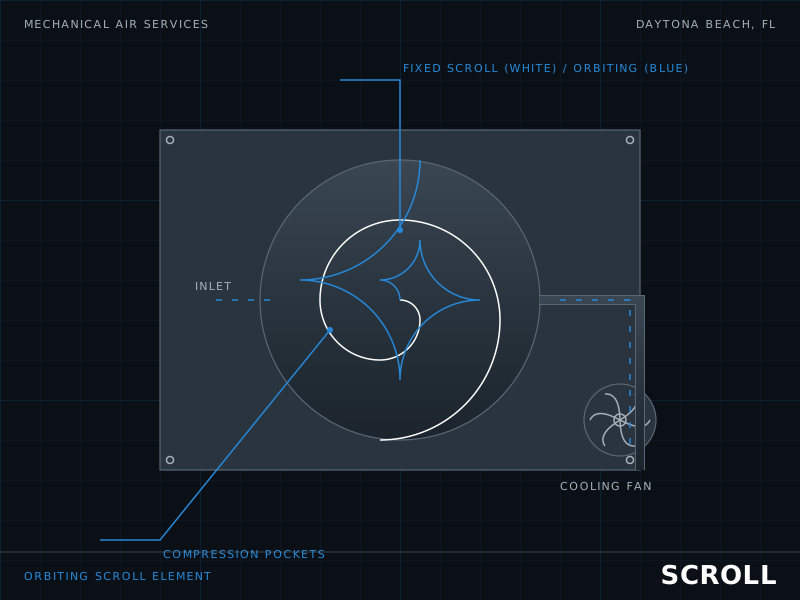
Scroll compressors compress air between a fixed and an orbiting spiral. They are quiet and compact, and are often found in medical, dental, laboratory and light commercial settings where clean air and low noise are priorities.

What we check

  • Intake filter replacement
  • Tip seal wear at service interval
  • Cooling fan and airflow
  • Dryer and filtration downstream
Request service for this type

Portable

Portable compressors — engine-driven tow-behind units and wheeled electric units — power pneumatic tools on job sites, in agriculture and in marine settings. Service covers the compressor element, drive and the fuel or electrical systems that support it.

What we check

  • Engine and compressor oil service
  • Air and fuel filters
  • Drive belt or coupling condition
  • Hose, fitting and gauge inspection
Request service for this type

Oil-Free

Oil-free compressors avoid lubricant in the compression chamber, which matters in food & beverage, medical, dental and finishing applications. Because designs vary widely by manufacturer, service scope is confirmed per machine.

What we check

  • Intake filtration
  • Coating and seal condition by design
  • Cooling system performance
  • Downstream dryers and sterile or coalescing filters
Request service for this type

Brands

Experience across leading compressor brands.

Brands serviced
7 manufacturers
Capability varies by model

Brands serviced

  • Ingersoll Rand Reciprocating and rotary screw compressors, dryers and parts.
  • Atlas Copco Rotary screw, oil-free and portable compressors.
  • Quincy Reciprocating and rotary screw compressors.
  • Sullair Rotary screw and portable compressors.
  • Kaeser Rotary screw compressors, dryers and controls.
  • Campbell Hausfeld Shop and light-commercial reciprocating compressors.
  • DeVilbiss Shop reciprocating compressors and air tools.

Brand names are the property of their respective owners. Service capabilities vary by model and equipment condition. Listing a brand does not imply official authorization or partnership unless stated.

FAQ

Equipment questions

01 What is the difference between a reciprocating and a rotary screw compressor?

A reciprocating compressor uses pistons and is designed for intermittent duty: it runs, fills a tank and rests. A rotary screw compressor uses two meshing rotors and is designed for continuous duty with smoother, quieter output. The right choice depends on how many hours a day you use air and how steady the demand is.

02 What does “oil-free” actually mean?

Oil-free compressors have no lubricant in the compression chamber, so the air they produce is not exposed to compressor oil. They are used where oil contamination is unacceptable, such as food, medical, dental and fine finishing. Designs vary widely by manufacturer.

03 Do you service every model from the brands you list?

No single shop can claim that honestly. We service most reciprocating, rotary screw, scroll and portable models from these brands, and we confirm capability for your specific machine before scheduling.

04 Are you an authorized dealer for these brands?

Listing a brand means we have experience servicing it; it does not imply official authorization or partnership unless we state it. Manufacturer authorization details will be published once confirmed.

05 Can you help me choose a compressor type?

Yes. Describe your tools, hours of use, required pressure and any air quality needs, and we will recommend a type and size as part of the installation conversation.

Next step

Not sure what you have?

Send a photo of the data plate with your service request and we will identify the machine and what it needs.

Typical inquiry response: within about one hour during business hours. This is a target, not a guarantee.