Signs Your Air Compressor Needs Repair
Pressure that will not build, new noises, heat trips and oil in the lines: the warning signs that a compressor needs attention before it fails.
Published by Mechanical Air Services LLC · Written from field experience; not professional engineering advice.
An air compressor rarely fails without warning. Most breakdowns are preceded by days or weeks of small changes that are easy to ignore while production is running. Learning to read those changes is the difference between a scheduled repair and an emergency call.
1. It takes longer to build pressure
If your compressor used to reach cut-out pressure quickly and now labors to get there, something has changed. On a reciprocating unit, worn valves, piston rings or a leaking head gasket let compressed air slip back past the stages. On a rotary screw unit, a worn air end, a sticking inlet valve or a clogged separator can all reduce output.
Before assuming the compressor is at fault, rule out the system: a new leak downstream can look exactly like a tired compressor.
2. It runs more often, or never stops
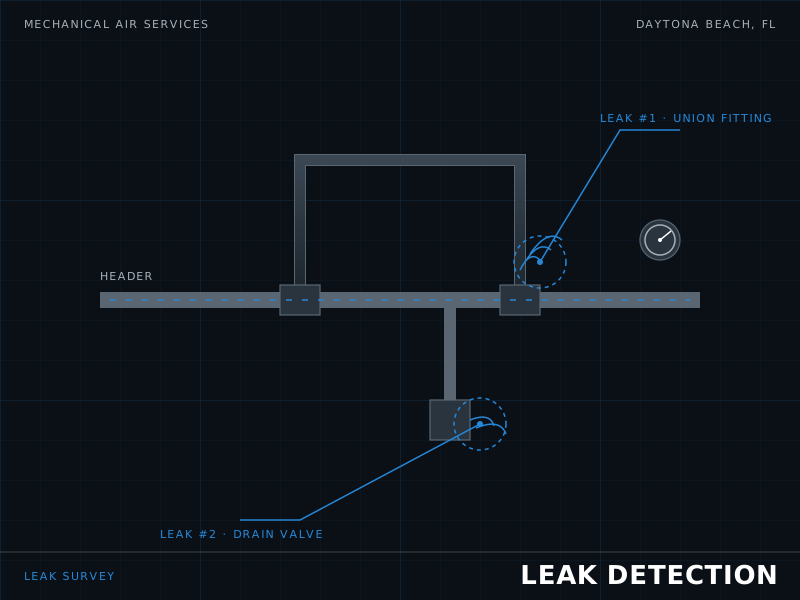
A compressor that cycles constantly or runs continuously at full load is either undersized for a demand that has grown, or it is feeding leaks. Walk the system during a quiet period and listen. Fittings, hose ends, quick couplers, drain valves and regulators are the usual suspects. A leak survey often recovers capacity you thought you had lost.
3. New noises or vibration
Compressors are loud, but they are consistently loud. Knocking, grinding, squealing or a rattle that was not there last month deserves attention:
- Knocking on a piston compressor can point to worn connecting rod bearings or a loose flywheel.
- Squealing usually means belt slip or a failing bearing.
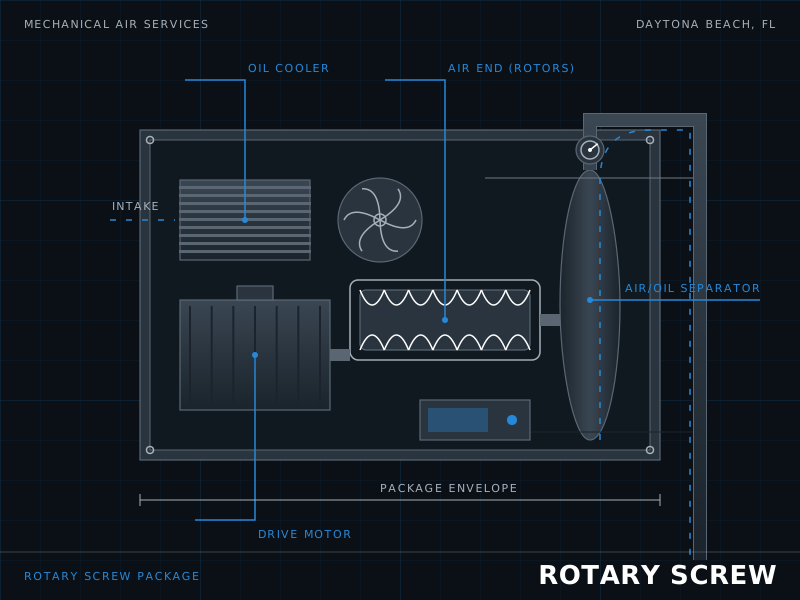
- Grinding or a rising whine on a rotary screw unit is a classic sign of air end bearing wear, and it should be checked before the bearings fail completely and damage the rotors.
4. High-temperature shutdowns
Most modern compressors protect themselves by shutting down on high discharge temperature. If yours is tripping, the common causes are low or degraded oil, a dirty oil cooler, a failed thermostatic valve, poor ventilation around the unit, or a cooling fan that is not moving enough air. Resetting and restarting without finding the cause shortens the life of the machine.
5. Oil in the air lines
Oil carry-over shows up as a film in filters, at tool exhausts, or as defects in paint and finishes. On a rotary screw unit it typically indicates a saturated or failed air/oil separator, a stuck scavenge line, an overfilled sump, or the wrong lubricant. On a reciprocating unit, worn rings are the usual culprit.
6. Moisture where it should not be
Water at the point of use is often a dryer or drain problem rather than a compressor fault, but it will damage tools and product just the same. Check automatic drains, dryer operation and dew point before it affects your work.
7. Electrical and control faults
Tripped breakers, contactors that chatter, a controller showing repeated faults, or a motor that hums without starting are signs that should not be cleared and ignored. Electrical faults are also a safety concern.
When to call
If you are seeing any of the above, note what changed and when, record the compressor’s hour-meter reading, and call before the unit stops. A repair visit scheduled around your operation is almost always less disruptive and less expensive than an emergency call-out after a failure.
If the compressor is already down and production is stopped, call the emergency line. Describe the symptoms, the make and model, and whether the unit will start at all. The more we know before we arrive, the faster the repair.